
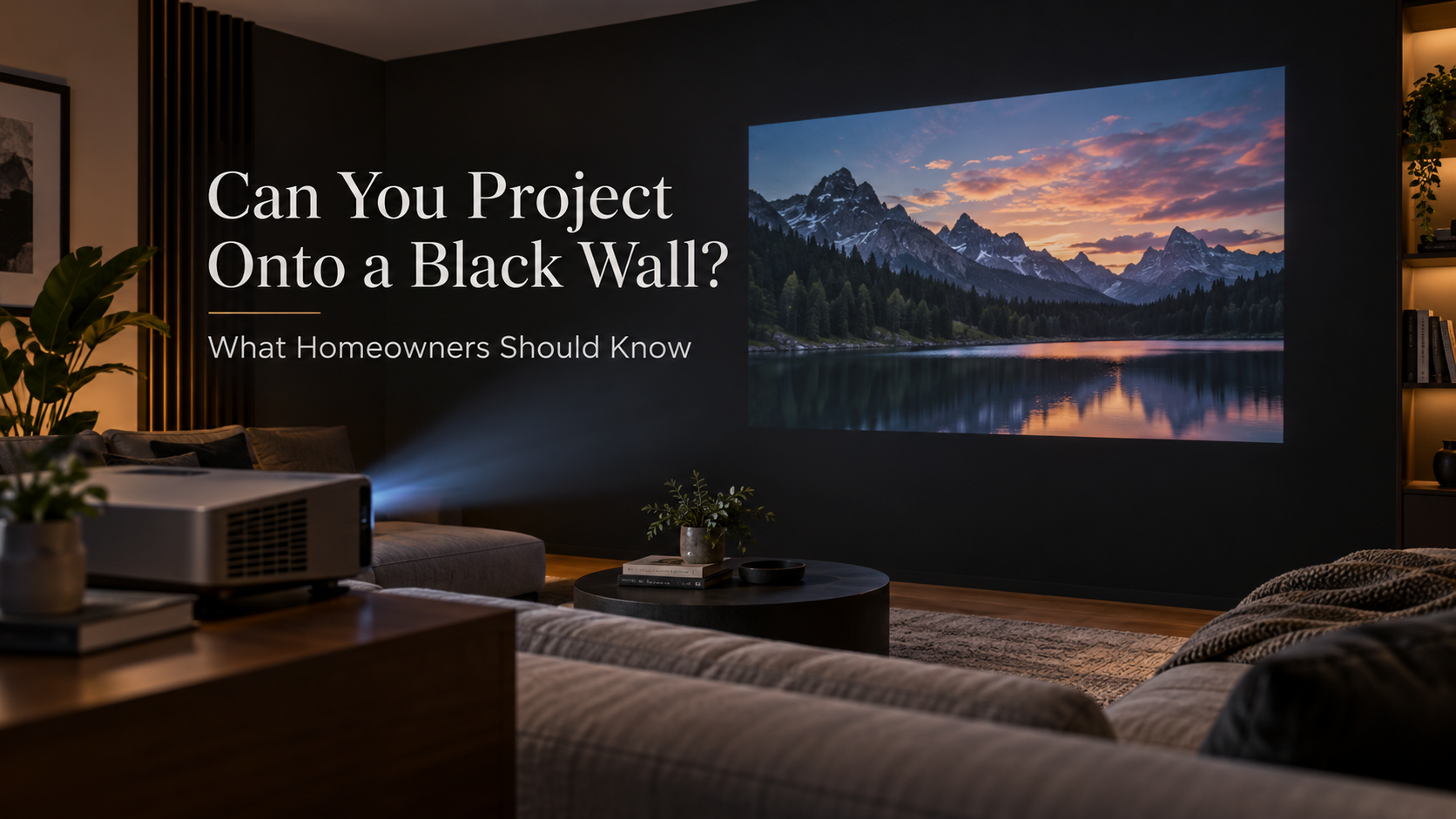
Can you project onto a black wall? Yes, a projector can create a visible image on a black wall, but that does not mean black is the ideal projection color. Dark paint absorbs much more of the projector’s light than a white or light-gray surface, so the picture will normally appear dimmer and bright colors may lose some of their impact.
However, wall color is only part of the equation. Paint sheen, surface texture, room lighting, projector brightness, image size, and even tiny imperfections in the drywall can influence what you see.
For homeowners creating a media room or occasional movie space, understanding the wall itself can help produce a noticeably better result.
Can You Project Onto a Black Wall Successfully?
You can, particularly when the room can be made very dark.
Projectors work by sending light toward a surface and relying on that surface to return light toward the viewer. White projection surfaces are popular because they reflect considerably lighter. Projector Central explains that screen gain is essentially a measure of how much light a projection surface reflects compared with a standard white reference surface.
A black surface absorbs considerably more of that light.
As a result, projecting onto black may produce:
- Lower overall image brightness
- Less brilliant whites and highlights
- More subdued colors
- Better-looking dark areas in some controlled rooms
- Greater dependence on a powerful projector
- Poorer performance when room lighting reaches the wall
If movie watching happens mainly at night with the room darkened, the compromise may be acceptable. For daytime viewing or a TV-like picture, it becomes much harder to overcome.
Black Projection Wall vs. Black Theater Walls
Here is an important distinction: painting the actual projection surface black is very different from painting the surrounding room dark.
Dark walls and ceilings around a proper projection screen can actually be beneficial because they absorb stray projector light instead of reflecting it back toward the image. Projector Central notes that dark gray and black room surfaces can help control reflected light in dedicated projection environments.
The projection area itself usually benefits from greater reflectivity.
For direct wall projection, a smooth matte white surface generally provides greater brightness, while a neutral light gray can trade some brightness for improved perceived black levels and contrast. Modern home-theater guidance continues to favor matte white for controlled dark rooms and suitable gray surfaces when contrast or ambient-light handling is a concern.
That often gives homeowners a better strategy:
Use darker paint around the viewing area, but keep the actual projection surface lighter and neutral.
Why Paint Finish Matters Almost as Much as Color
If someone asks, can you project onto a black wall if the paint is glossy? the answer is still technically yes, but gloss creates another problem.
Glossy and semi-gloss finishes reflect light more directly. Instead of producing an evenly illuminated picture, they can create distracting reflections or bright areas.
Matte or Flat Is Usually Better
For a painted projection wall, a flat or matte finish generally creates a more uniform surface.
Sherwin-Williams describes flat paint as essentially non-reflective, while gloss finishes are much more reflective.
That makes sheen particularly important in media rooms.
A good projection wall should ideally be:
- Matte or flat
- Uniform in color
- Free from shiny patches
- Smoothly rolled or sprayed
- Properly repaired before painting
A dark matte wall will still absorb considerable projector light, but at least it avoids adding glare to the brightness problem.
Your Wall Texture Can Show Up in the Movie
Homeowners often focus entirely on paint color while overlooking the condition of the drywall.
Projectors enlarge everything.
Small dents, patched nail holes, heavy roller texture, uneven drywall joints, and raised repair areas that are hardly noticeable during normal daylight may suddenly become visible across a 100-inch projected image.
Prepare the Wall Like a Finish Surface
Before repainting a wall that will regularly be used for projection:
- Remove nails and unwanted hardware.
- Fill dents and holes.
- Repair damaged drywall.
- Sand patches until their edges disappear.
- Check the wall under light coming from the side.
- Remove sanding dust.
- Prime repaired sections properly.
- Apply a consistent finish coat.
The smoother and more uniform the surface, the less the wall itself interferes with the picture.
Ultra-Short-Throw Projectors Need Even More Attention
Wall flatness becomes especially important with short-throw and ultra-short-throw projectors.
Because these projectors send light toward the wall from a steep angle, small waves or irregularities in the surface can become more obvious. BenQ specifically notes that short-throw projectors are highly sensitive to surface flatness and recommends a taut screen for optimal performance. Epson likewise specifies a flat, smooth and unwarped surface for certain ultra-short-throw installations.
So before buying premium equipment, inspect the wall carefully. A projector cannot correct every physical defect in the surface it is illuminating.
Ambient Light Can Matter More Than Wall Color
Even an excellent projector can struggle when sunlight, ceiling lights, or lamps shine directly onto the viewing area.
Ambient light reduces visible contrast. Projector testing consistently shows that additional room lighting can wash out colors and contrast, even when a conventional white screen is being used.
On a black wall, where less projector light is already reaching the viewer, controlling room light becomes even more important.
Try:
- Blackout curtains or blinds
- Switching off lights near the projection wall
- Moving lamps behind the viewing position
- Preventing ceiling lights from shining directly onto the image
- Watching after sunset when complete light control is possible
Sometimes improving light control produces a greater difference than changing projector settings.
Should You Repaint a Black Wall for Projection?
If projection will only happen occasionally, test the existing black wall first. You may decide the image is perfectly acceptable for casual movie nights.
If the wall will become your primary viewing surface, however, repainting the projection area may be worthwhile.
Consider a smooth matte white when maximum brightness is the priority. A neutral light gray may be worth testing when you want a compromise between brightness and perceived contrast.
Another attractive approach is creating a defined lighter projection rectangle while keeping the surrounding wall dark. When the projector is switched on, the lighter section functions more like a viewing surface; when it is off, the dark surrounding color still gives the room a home-theater feel.
When Is a Projector Screen the Better Choice?
Paint can create a very usable projection wall, but it cannot reproduce every property of an engineered screen.
A dedicated screen becomes more attractive when:
- Image quality is a major priority
- The projector is used every day
- The room has unavoidable ambient light
- You use an ultra-short-throw projector
- Wall texture remains visible
- You want consistent brightness across a large image
- Precise color reproduction matters
Some modern projectors also include wall-color correction features. BenQ, for example, offers models capable of compensating for several wall colors, including blackboard-like surfaces. Such correction can improve color balance, but it cannot change the fundamental reflectivity of the wall itself.
So, Can You Project Onto a Black Wall?
Can you project onto a black wall? Absolutely, and in a completely dark room with a sufficiently bright projector, the result can be enjoyable. But black paint absorbs valuable projector light, making it a compromise rather than the default choice for most home projection setups.
If picture quality matters, concentrate on four things: wall color, matte sheen, smooth preparation, and room light control. Before buying a new projector, it may even be worth improving the wall first. Homeowners who need drywall preparation, surface correction, or a professionally finished media-room wall can work with experienced Painters in Davidson nc to create a smoother, cleaner surface that works with both the room design and the intended projection setup.