
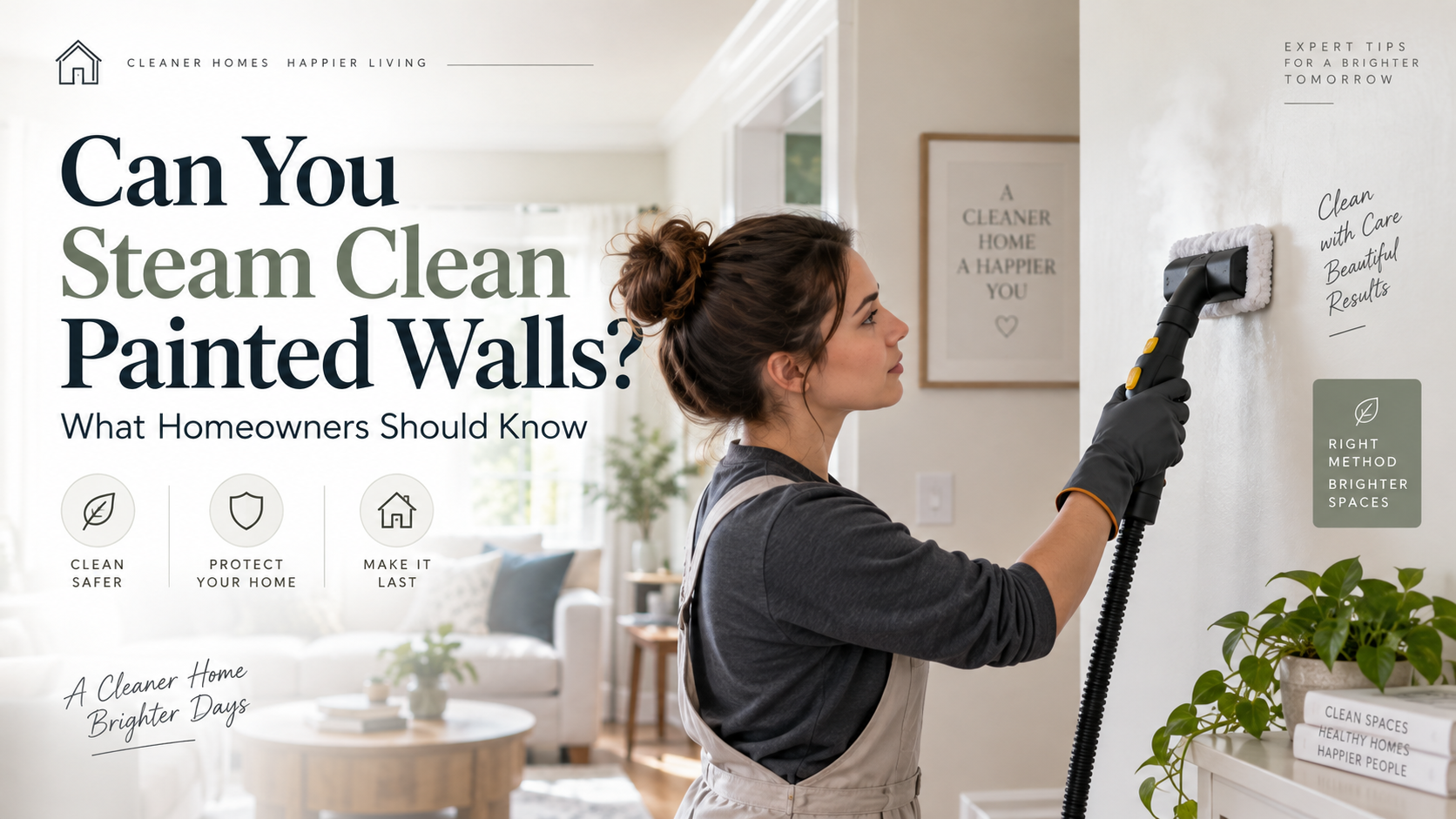
Can you steam clean painted walls? The answer depends less on the steam cleaner itself and more on what is happening on the wall.
A greasy kitchen wall, a recently painted bedroom, a semi-gloss bathroom, and an old matte hallway may all react very differently to heat and moisture.
That is why the safest way to answer the question is not with a simple yes or no. It is to look at the situation.
Below are five common household scenarios and what homeowners should consider before putting steam anywhere near painted drywall.
Situation 1: The Kitchen Wall Has Grease Around the Stove
Kitchen walls are one of the first places homeowners consider using steam.
Cooking grease can create a film that ordinary dusting will not remove, especially around stoves, range hoods, backsplashes, and food-preparation areas.
Should You Use Steam?
Maybe, but only if the painted surface is durable, fully cured, and the paint manufacturer allows it.
Kitchen walls are often coated with satin or semi-gloss paint because these finishes tolerate cleaning better than flat paint. However, that does not automatically make steam safe.
The bigger concern is dwell time.
Holding hot vapor over one patch can soften the coating or affect its sheen. Instead of making a greasy wall look cleaner, the result may be a shiny or discolored patch that is more obvious than the original stain.
A Better First Step
Try:
- Warm water
- Mild dish soap
- A microfiber cloth
- Light pressure
- Small cleaning sections
If grease remains after gentle cleaning, the wall may need a stronger surface-safe cleaner or eventually a new coat of paint.
Situation 2: The Bathroom Has Moisture Marks
Bathrooms are different because walls already face humidity on a regular basis.
Homeowners often assume that because bathroom paint is designed for moisture, a steam cleaner should be safe.
That assumption can be risky.
Moisture-Resistant Does Not Mean Steam-Proof
Bathroom paint may tolerate condensation better than ordinary flat wall paint, but a steam cleaner delivers concentrated heat and moisture directly to the surface.
That is very different from normal bathroom humidity.
If the wall already has:
- Peeling paint
- Bubbling
- Cracked caulk
- Water staining
- Soft drywall
- Mold-related discoloration
steam can make the underlying problem worse.
In this situation, cleaning is not always the real issue.
The source of the moisture may need attention first.
Situation 3: Your Child Has Drawn on the Wall
Crayon, pencil, fingerprints, marker, and food smears are common on walls in family homes.
This is another situation where homeowners may ask, can you steam clean painted walls to remove stubborn marks?
The answer depends heavily on the stain and paint finish.
Do Not Attack the Mark Immediately
Start with the gentlest method possible.
A soft damp cloth may remove fingerprints and washable marks easily. Mild soap can help with more stubborn grime.
If you use too much force, you may remove or polish the paint before removing the stain.
This is particularly noticeable on matte and flat finishes.
Repeated rubbing can create a shiny patch known as burnishing, meaning the wall may technically be clean but still look damaged.
For permanent marker, crayon, or deep staining, repainting a small area may ultimately produce a better visual result than aggressive cleaning.
Situation 4: The Wall Was Painted Recently
This is one of the clearest cases where patience matters.
Fresh paint can feel dry within hours but still need much longer to fully cure.
Benjamin Moore advises allowing freshly painted surfaces around 30 days before normal cleaning.
Why Curing Matters
During curing, the coating is still developing its final hardness and durability.
Steam introduces both heat and moisture during this vulnerable period.
Using it too soon can lead to:
- Softened paint
- Surface marks
- Color variation
- Loss of sheen
- Peeling in weak areas
If a newly painted wall becomes dirty, gently dust it first and avoid aggressive cleaning.
A small imperfection is easier to live with for a few weeks than an entire damaged paint section.
Situation 5: The Wall Is Old, Scuffed and Already Peeling
This is where homeowners sometimes spend too much time trying to clean a surface that actually needs repainting.
Old paint may have:
- Multiple touch-up patches
- Years of fingerprints and scuffs
- Fading
- Cracks
- Poor adhesion
- Previous water damage
- Uneven sheen
Steam is unlikely to solve these problems.
In fact, heat and moisture can make failing paint detach even faster.
The Wall May Be Telling You It Is Time to Repaint
Cleaning works best when the coating underneath is still healthy.
If the finish itself is deteriorating, the better solution is usually:
- Repair damaged drywall.
- Scrape or sand loose paint.
- Clean the surface.
- Prime repaired areas.
- Apply a fresh, suitable finish.
That creates a much more uniform result than repeatedly trying stronger cleaning methods.
The Paint Finish Changes Everything
When homeowners ask can you steam clean painted walls, the paint sheen is one of the most important clues.
Flat and Matte
These finishes hide surface imperfections well but are usually the least forgiving during aggressive cleaning.
They can show:
- Water marks
- Burnishing
- Uneven sheen
- Visible rubbed areas
Steam is generally not the best first choice.
Eggshell
Eggshell offers slightly more durability but should still be cleaned gently.
It is common in living rooms, bedrooms, and hallways where homeowners want some washability without obvious shine.
Satin and Semi-Gloss
These finishes are typically more washable and are commonly used in kitchens, bathrooms, trim, and high-contact areas.
Even here, direct steam should only be used if the coating manufacturer and steam-cleaner instructions allow it.
A Simple “Stop or Continue” Test
Instead of committing to an entire wall, inspect one hidden area first.
Choose a spot:
- Behind furniture
- Inside a closet
- Near the bottom corner of the room
After testing, look for changes in:
- Color
- Shine
- Texture
- Adhesion
- Softness
- Bubbling
If any of these change, stop.
The wall has already given you the answer.
What About Wallpapered or Partially Repaired Walls?
Steam should be treated with even more caution around wallpaper.
Heat and moisture can loosen wallpaper adhesive, which is why steam is commonly used intentionally during wallpaper removal.
The same problem can occur around:
- Wallpaper borders
- Decorative coverings
- Poorly sealed drywall repairs
- Cracked joint compound
Steam can enter weak areas that ordinary surface cleaning might never affect.
Sometimes Cleaning Is Not the Goal
One useful way to think about this question is to ask:
What are you actually trying to fix?
- If the wall is dusty, clean it.
- If it is greasy, degrease it carefully.
- If it is stained, try a safe spot treatment.
- If it is peeling, repair it.
- If it is faded and worn, repaint it.
- Using the wrong solution for the wrong problem often creates more work.
The Better Answer for Most Painted Walls
So, can you steam clean painted walls? In selected situations, perhaps. But it should not be treated as a universal cleaning method.
For most painted interior walls, the safer order is simple:
Start dry, move to slightly damp, add mild soap if necessary, and only consider stronger methods when the paint condition and manufacturer guidance support them.
The important thing is protecting the finish rather than trying to remove dirt as aggressively as possible.
If cleaning reveals that the real problem is failed paint, damaged drywall, uneven touch-ups, or years of wear, restoring the wall properly will usually create a better result than continuing to scrub or steam it. Homeowners who want those surfaces repaired and professionally refinished can work with experienced painters in fort mill sc to bring the walls back to a clean, consistent finish.