
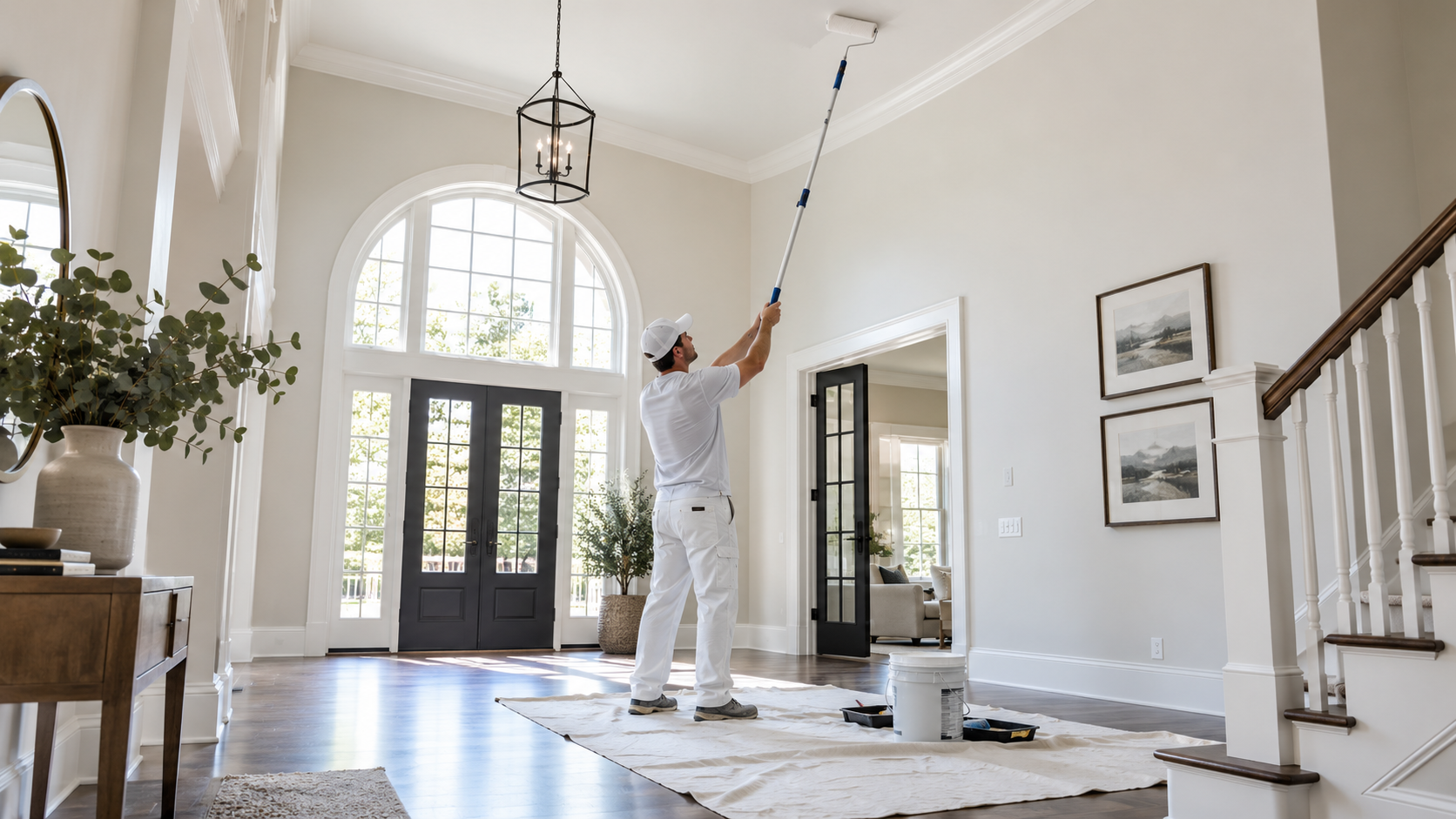
Learning how to paint a high ceiling is partly about painting technique and partly about safe access. A standard eight- or nine-foot ceiling can often be handled with an extension pole. A two-story foyer, vaulted ceiling, or ceiling above stairs may require ladders, specialized leveling equipment, or interior scaffolding.
Benjamin Moore classifies painting high walls and ceilings above stairs as an advanced project and recommends considering a professional for spaces over about 10 feet because of the access and safety challenges.
Plan How You Will Reach Every Section First
Do not start painting the easy center section before deciding how you will reach:
- Ceiling edges
- Corners
- Areas around beams
- Light fixtures
- Sloped sections
- Ceiling areas above stairs
A reach plan prevents unsafe improvisation halfway through the job.
Use an Extension Pole Wherever Practical
A quality roller extension pole is one of the most valuable tools for high ceilings.
It allows more work to be completed from the floor and reduces repeated climbing.
Choose a pole long enough to reach comfortably without becoming difficult to control.
For cutting in, purpose-made brush or edging-tool adapters can sometimes extend your reach. Benjamin Moore specifically lists extension-pole adapters and edging tools among the equipment useful for tall spaces.
When a Ladder or Scaffolding Is Necessary
Some ceiling edges simply cannot be reached accurately from the floor.
Use equipment designed for the height and working surface.
For very tall spaces, rental scaffolding can provide a larger and more stable work platform than repeatedly relocating a ladder.
Never improvise a platform from furniture, boxes, loose boards, or other household objects.
Protect More Floor Than You Think You Need
Ceiling paint can produce fine roller splatter across a broad area.
Before opening the paint:
- Remove movable furniture.
- Cover remaining furniture.
- Protect the entire floor below the work zone.
- Cover stair rails where appropriate.
- Remove or protect light fixtures.
- Keep walking paths clear.
High-ceiling projects require extra room to maneuver long extension poles safely.
Repair the Ceiling Before Painting
Height does not make imperfections disappear.
Bright natural light can actually make old patches, cracks, and uneven textures more obvious.
Inspect for:
- Nail pops
- Hairline cracks
- Water stains
- Peeling paint
- Poor previous repairs
- Dust and cobwebs
Address the cause of water stains before repainting.
Cut In Before Rolling
Use an angled brush, edging tool, or suitable extension adapter to paint around the perimeter.
Work in manageable sections.
Benjamin Moore recommends starting by cutting ceiling edges before switching to a roller for the broader areas.
If your project includes tall walls as well, Century Painting’s guide to painting high walls provides additional guidance on maintaining reach and consistent coverage.
Roll in Controlled Sections
Load the roller evenly and avoid pressing excessively.
Too much pressure can produce:
- Roller lines
- Uneven coverage
- Excess splatter
- Fatigue
- Thin sections where paint is squeezed from the roller
Work systematically rather than randomly moving across the ceiling.
Maintain a wet edge where practical so adjoining sections blend smoothly.
Use Good Lighting
High ceilings frequently contain shadows, especially in foyers or rooms with dramatic rooflines.
Temporary work lights can reveal:
- Missed spots
- Uneven coverage
- Roller lines
- Thin paint
- Unrepaired defects
Inspect from the floor periodically rather than waiting until everything has dried.
Flat Ceiling Paint Is Often Forgiving
Ceiling coatings are commonly formulated with low sheen because flatter finishes reflect less light and tend to make minor surface variations less obvious.
The appropriate product still depends on the room.
Bathrooms, kitchens, and other areas may have different coating requirements than a dry living room or foyer.
Let the First Coat Dry Properly
Do not rush a second coat because repositioning tall-access equipment is inconvenient.
Follow the paint manufacturer’s recoat instructions.
A second coat applied too soon can disturb the first coat or produce inconsistent texture.
High Ceilings Above Stairs Deserve Extra Caution
Staircases create uneven working levels and make ladder placement considerably more complicated.
Benjamin Moore recommends equipment such as a ladder leveler or scaffolding where appropriate and advises professional help when the setup feels unsafe.
There is no paint finish worth risking a fall.
Reach and Finish Quality Need to Work Together
The key to how to paint a high ceiling is planning access before application begins. Use an extension pole from the floor wherever practical, establish safe access for edges and difficult areas, protect the entire work zone, repair defects first, and apply paint systematically while maintaining consistent coverage. If the project involves vaulted architecture, stairwells, two-story foyers, or access that requires specialized equipment, experienced interior painters in charlotte nc can complete the ceiling and adjoining surfaces without turning access problems into painting problems.