
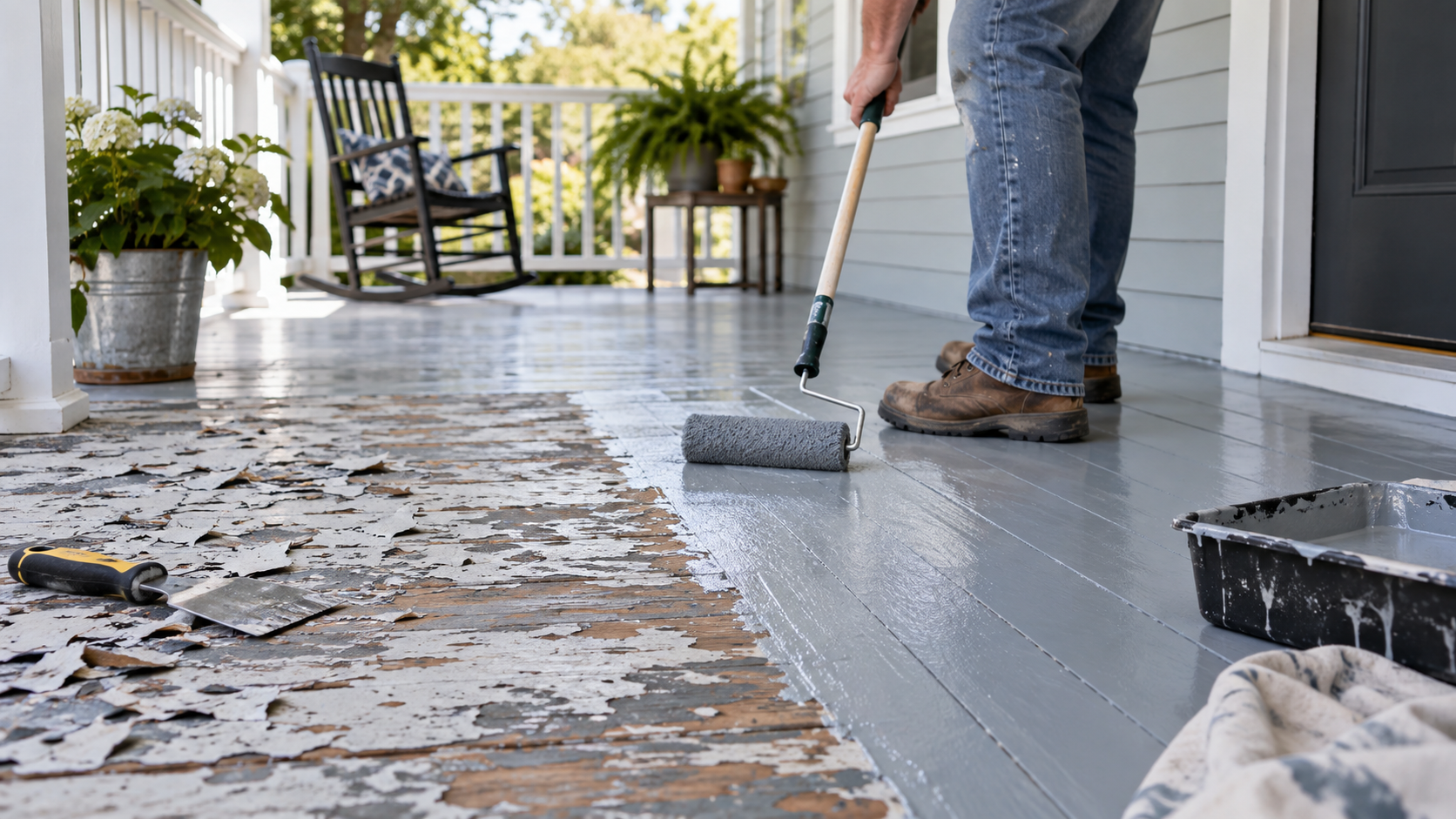
Learning how to repaint a porch floor is different from painting unfinished flooring for the first time. The new coating must bond not only to the porch material but also to whatever old paint remains after preparation.
That makes evaluation and adhesion the two most important parts of the project.
Start by Deciding Whether the Old Paint Is Sound
Closely inspect the floor.
If most of the coating is firmly bonded and only a few isolated sections are worn, complete stripping may not be necessary.
If paint is peeling across large areas, however, simply adding another coat will reproduce the same problem.
Look for:
- Peeling
- Blistering
- Cracking
- Bare wood
- Soft boards
- Heavy wear paths
- Moisture damage
- Loose fasteners
Find Out Why the Old Paint Failed
Before asking how to repaint a porch floor, ask why repainting is already necessary.
Possible causes include:
- Poor previous preparation
- Moisture
- Incompatible coatings
- Painting damp wood
- Ordinary exterior paint used instead of floor enamel
- Heavy traffic
- Rotten or unstable boards
If the underlying cause remains, new paint may fail again.
Clean Before Sanding
Dirt and contamination should not be ground into the surface during sanding.
Remove furniture and rugs, sweep thoroughly, and clean the porch using a product compatible with the floor and planned coating.
Allow it to dry according to the coating system requirements.
Remove Loose Paint
Use a scraper to remove coating that is no longer firmly attached.
Do not gouge the wood simply to remove every microscopic trace of old paint.
The goal is a stable surface.
If your porch has extensive failed coating, Century Painting’s guide to remove old paint from wood explains scraping, stripping, washing, and sanding considerations in greater detail.
Feather the Paint Edges
After scraping, abrupt ridges may remain where old paint meets bare substrate.
Sand these transitions so they are less visible through the new finish.
Sherwin-Williams’ porch-floor procedure similarly recommends repairing imperfections, allowing filler to dry, sanding, and wiping the surface clean before repainting.
Address Bare and Damaged Areas
Inspect exposed wood carefully.
Replace boards that are rotten or structurally unsound.
Secure raised fasteners and correct cracks or defects as appropriate.
Bare sections may require primer depending on the floor coating system.
Check Coating Compatibility
Not every new product can be applied over every old finish.
Read the technical instructions for the floor coating you intend to use.
If you cannot identify the old coating, a professional assessment or a small adhesion test can help avoid an expensive whole-floor failure.
Use a Real Porch-and-Floor Coating
A porch floor must resist repeated walking and outdoor exposure.
Ordinary exterior siding paint is not designed for that job.
Select a coating specifically approved for your floor material and exterior foot traffic.
Benjamin Moore identifies dedicated floor and patio latex enamel for porch and patio applications, while Sherwin-Williams provides similar porch-and-floor systems.
Apply the First Coat Methodically
Cut around edges, columns, posts, and steps with a brush.
For wood flooring, roll along the direction of the boards.
Keep the coating even rather than trying to achieve maximum hiding with one heavy application.
Heavy coats can dry slowly and create uneven texture.
Allow the Proper Recoat Time
Follow the product label.
Do not assume that because the surface feels dry, another coat can immediately be applied.
Temperature and humidity affect drying.
Apply a Second Coat When Specified
A second coat can improve uniformity and provide the coating thickness intended by the manufacturer.
Sherwin-Williams’ Purdy porch-floor instructions call for a second coat after the first has properly dried.
Keep Furniture Off Until the Finish Is Ready
The final coat may be vulnerable to pressure from chair legs, rugs, grills, and planters even after light foot traffic becomes possible.
Wait for the manufacturer’s stated service time.
Repainting Is Mostly a Preparation Project
The most important part of how to repaint a porch floor happens before the fresh color appears. Determine why the previous finish failed, remove loose coating, feather edges, repair the substrate, clean thoroughly, and make sure the new porch-and-floor product is compatible with what remains. For heavily weathered floors or porches that also need exterior trim and wood repairs, experienced exterior painting professionals can evaluate whether the floor needs spot preparation, extensive stripping, priming, or a complete refinishing system.