
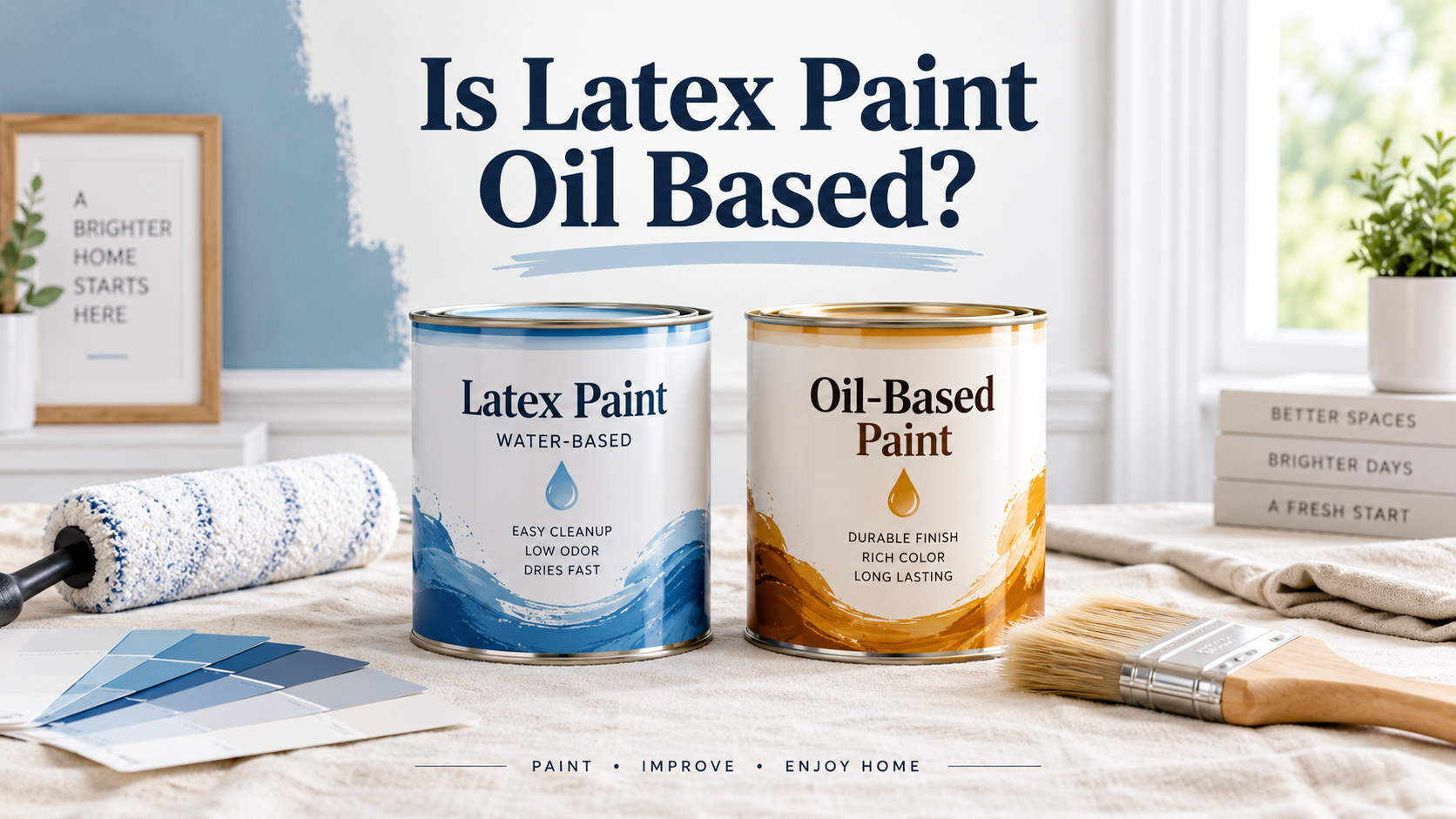
If you have ever stood in the paint aisle trying to compare latex, acrylic, and oil-based products, the terminology can quickly become confusing. One of the most common questions homeowners ask is: is latex paint oil based?
The short answer is no. Latex paint is generally a water-based paint, while traditional oil-based paint uses an oil or alkyd binder and typically requires mineral spirits or another appropriate solvent for cleanup.
The word “latex” creates some confusion because it sounds like a specific ingredient. In modern architectural paint, however, latex usually refers to water-based paint made with synthetic polymer binders such as acrylic or vinyl-acrylic resins. It does not mean the paint is made from natural rubber latex.
Understanding this difference matters because paint type affects drying time, cleanup, odor, durability, surface preparation, and whether a new coating will properly adhere to an older one.
Is Latex Paint Oil Based or Water Based?
When homeowners ask is latex paint oil based, the simplest answer is:
Latex paint is water based, not oil based.
Water acts as the primary carrier in latex paint. As the paint dries, the water evaporates and the remaining pigments and synthetic resin form a solid coating on the surface.
Traditional oil-based paint works differently. It uses an oil or alkyd resin system and usually dries through both solvent evaporation and a chemical curing process.
This fundamental difference affects nearly every aspect of how the two paints behave.
Quick Comparison
| Feature | Latex Paint | Oil-Based Paint |
|---|---|---|
| Base | Water | Oil or alkyd |
| Cleanup | Soap and water | Mineral spirits or paint thinner |
| Drying | Usually faster | Usually slower |
| Odor | Generally lower | Typically stronger |
| Flexibility | Good | Less flexible after curing |
| Yellowing | Minimal | Can yellow over time |
| Brush leveling | Good, varies by product | Traditionally excellent |
| Common uses | Walls, ceilings, siding, many trims | Select trim, metal, specialty surfaces |
| Recoat time | Usually shorter | Usually longer |
Modern paint technology has narrowed many of the performance differences, so the best product depends more on the surface and application than on whether one category is universally “better.”
Why Is It Called Latex Paint If It Does Not Contain Rubber Latex?
This is where much of the confusion begins.
The term “latex” originally described a type of polymer dispersion suspended in water. Paint manufacturers adopted the term because the synthetic resin particles behaved somewhat like natural latex when dispersed in liquid.
Today’s household latex paints usually use synthetic binders such as:
- Acrylic
- Vinyl acrylic
- Styrene acrylic
- Other engineered polymer resins
These particles are suspended in water.
When the paint is applied, the water evaporates and the resin particles come together to create a continuous paint film.
So, despite the name, modern architectural latex paint generally does not mean natural rubber latex paint.
Is Acrylic Paint the Same as Latex Paint?
Acrylic and latex paint are closely related, but the names are not always interchangeable.
Many modern paints labeled as latex are actually acrylic-based waterborne coatings.
Acrylic Paint
Acrylic paint uses acrylic resin as an important part of its binder system.
High-quality 100% acrylic architectural paints are popular because they can provide:
- Strong adhesion
- Good flexibility
- Resistance to fading
- Moisture resistance
- Good color retention
- Exterior durability
Because exterior surfaces expand, contract, heat up, cool down, and receive repeated weather exposure, flexibility can be particularly useful.
Vinyl-Acrylic Latex Paint
Some economical latex paints use vinyl-acrylic binders.
These products can work very well for many interior applications, especially walls and ceilings where weather resistance is not a concern.
The important lesson is that “latex” describes the broad water-based category, while acrylic often describes the resin technology used inside that category.
How Oil-Based Paint Is Different
Oil-based paint has historically been valued for its smooth finish and hard cured surface.
Traditional formulations tend to level well after brushing, allowing brush marks to soften as the coating dries.
That made oil-based paints popular for:
- Doors
- Trim
- Cabinets
- Railings
- Furniture
- Metal surfaces
- High-contact architectural details
However, conventional oil-based products also have characteristics that make them less convenient for many residential projects.
These commonly include:
- Longer drying times
- Stronger odor
- Solvent-based cleanup
- Greater tendency to yellow over time
- Less flexibility than many acrylic coatings
- Higher VOC levels in many traditional formulations
Because paint technology has advanced substantially, modern waterborne acrylics and waterborne alkyd products can now provide excellent durability without all the traditional characteristics of conventional oil paint.
Why Latex Paint Became So Popular
Water-based latex products dominate many residential painting applications today because they combine convenience with strong performance.
Faster Drying
Latex paint normally dries and can be recoated sooner than traditional oil-based paint.
That can allow painters to complete multiple stages of a project without waiting as long between coats.
Easier Cleanup
Most latex paint can be cleaned from brushes, rollers, and tools with soap and water while it is still wet.
Oil-based coatings usually require an appropriate solvent.
Lower Odor
Water-based products generally create less intense odor than traditional solvent-based oil paints.
This makes them especially convenient for occupied homes.
Flexibility
Exterior materials expand and contract as temperatures and moisture levels change.
Quality acrylic latex coatings can flex with those movements more effectively than some older, harder oil-based films.
Color Retention
High-quality acrylic exterior paints tend to resist fading and yellowing well.
This can be particularly helpful on:
- Exterior siding
- Trim
- Doors
- Sunny elevations
- Strongly colored surfaces
Does Oil-Based Paint Still Have Advantages?
Yes.
Oil-based paint has not historically been popular without reason.
A properly applied oil or alkyd coating can provide a very smooth, hard finish.
Its slower drying time can allow brush marks to level before the paint sets.
Oil-based coatings may still be appropriate for specific applications depending on the substrate and product requirements.
However, homeowners should not automatically assume that oil is more durable simply because it dries harder.
A coating that is extremely hard but cannot accommodate movement can crack or become brittle in certain conditions.
Modern high-performance waterborne products can equal or outperform older coatings in many residential situations.
How to Tell Whether Existing Paint Is Latex or Oil Based
Knowing what is already on the surface is important before repainting.
Applying incompatible products without proper preparation can result in poor adhesion.
Start With the Age of the Surface
If the coating is relatively recent, it is more likely to be water-based because latex and acrylic products have become dominant in residential painting.
Older trim, doors, cabinets, and woodwork are more likely to have oil-based coatings underneath newer layers.
Age alone, however, is not a reliable test.
Look at the Appearance
Older oil-based finishes often develop:
- A very smooth appearance
- Harder surfaces
- Yellowing, particularly on white paint
- Fine cracking as the coating ages
Latex tends to remain more flexible and usually does not yellow the same way.
Again, appearance alone cannot provide complete certainty.
Use a Suitable Coating Test
Professional painters can test an inconspicuous section of the existing coating to help identify its type.
This is often preferable to guessing because repainting over an incompatible or poorly prepared coating can lead to peeling later.
Can You Put Latex Paint Over Oil-Based Paint?
Yes, but proper preparation is essential.
This is one of the most important practical issues when dealing with older homes.
Applying latex paint directly over a slick oil-based finish without preparation can cause adhesion problems.
The new coating may initially look fine and later:
- Scratch easily
- Chip
- Peel
- Separate around edges
- Pull off during cleaning
Proper Preparation May Include
Depending on the surface and products being used, preparation may involve:
- Cleaning grease and contamination
- Removing loose material
- Scuff sanding glossy surfaces
- Repairing cracks or defects
- Removing sanding dust
- Applying a compatible bonding primer
- Applying the appropriate finish coat
Always follow the coating manufacturer’s recommendations because modern products vary considerably.
Can Oil-Based Paint Go Over Latex Paint?
It may be possible in certain applications, but preparation and product compatibility still matter.
A sound latex coating can sometimes accept an appropriate oil or alkyd product when the surface is properly cleaned, dull, and prepared.
The bigger question is whether there is a practical reason to switch.
Modern waterborne coatings often provide the performance homeowners want without introducing a traditional solvent-based system.
Instead of choosing paint solely by category, consider:
- Surface material
- Existing coating
- Required durability
- Finish
- Exposure
- Maintenance
- Manufacturer recommendations
What Is Waterborne Alkyd Paint?
Waterborne alkyd paint is one reason today’s paint terminology can be confusing.
These products are designed to provide some of the leveling and durable finish traditionally associated with alkyd paint while using water as an important part of the carrier system.
Depending on the formulation, waterborne alkyd products may offer:
- Smooth leveling
- Hard finish
- Easier cleanup
- Lower odor than traditional oil
- Faster drying
- Strong durability
They are often considered for doors, cabinets, trim, and other surfaces where homeowners want a smoother, furniture-like finish.
This category demonstrates why simply dividing all modern paint into “latex versus oil” does not tell the whole story anymore.
Latex vs. Oil-Based Paint for Interior Walls
For most modern residential walls, high-quality latex or acrylic paint is the practical choice.
Walls benefit from:
- Quick drying
- Easy touch-ups
- Low odor
- Washability
- Color selection
- Soap-and-water cleanup
Oil-based paint is rarely necessary for ordinary drywall.
Today’s premium interior water-based paints can provide excellent stain resistance and washability.
What About Ceilings?
Latex paint is commonly used on ceilings.
Flat or matte ceiling coatings help reduce light reflection and can make minor surface imperfections less visible.
They also dry relatively quickly and make cleanup easier during large projects.
Latex vs. Oil Paint for Trim and Doors
Trim and doors are more demanding because they receive frequent contact.
Older homes often have oil-painted:
- Baseboards
- Window trim
- Door casings
- Interior doors
- Crown molding
Today, painters may use premium acrylic enamel or waterborne alkyd products instead.
These modern coatings can provide durability while reducing some of the odor and cleanup challenges associated with traditional oil paint.
The existing coating must still be identified and prepared correctly.
Which Paint Is Better for Exterior Surfaces?
High-quality 100% acrylic exterior paint is widely used for siding, trim, and many exterior applications.
Its advantages include:
- Flexibility
- UV resistance
- Strong color retention
- Moisture resistance
- Good adhesion when properly applied
- Resistance to cracking and peeling
Exterior paint must withstand much more movement and environmental stress than interior paint.
That makes product quality and surface preparation particularly important.
Common Mistakes When Choosing Between Latex and Oil Paint
Understanding the differences can prevent expensive repainting problems.
Assuming All Latex Paint Is the Same
A budget vinyl-acrylic wall paint and a premium 100% acrylic exterior coating are both technically water-based paints, but their performance can be very different.
Always choose a product designed for the specific application.
Painting Over Glossy Surfaces Without Preparation
Glossy coatings provide less surface texture for the next layer to grip.
Cleaning, sanding, and sometimes priming may be necessary.
Ignoring the Existing Coating
New paint must bond to what is underneath.
A premium finish coat applied over an unstable layer can still fail.
Using Interior Paint Outside
Interior paint is not formulated for continuous UV, rain, humidity, and temperature changes.
Always select a coating rated for exterior exposure.
Believing Harder Always Means Better
A harder paint is not automatically the best paint.
Some surfaces benefit from flexibility because the material expands and contracts.
How Paint Finish Changes Performance
Paint chemistry is only part of the decision.
Sheen also changes how a painted surface behaves.
Common finishes include:
- Flat
- Matte
- Eggshell
- Satin
- Semi-gloss
- Gloss
Higher-sheen finishes are generally easier to wipe clean, although they can also highlight surface imperfections.
Flat and matte paints reduce reflections and can hide minor imperfections more effectively.
The right combination of chemistry and sheen depends on where the paint will be used.
Which Paint Should You Choose?
Instead of asking whether latex or oil is always better, match the coating to the project.
Consider Latex or Acrylic for:
- Interior walls
- Ceilings
- Exterior siding
- Many exterior trims
- Large residential surfaces
- Areas where faster drying is valuable
- Projects where easy cleanup matters
Consider Specialty Alkyd or Oil-Type Products for:
- Certain metal applications
- Specialty priming situations
- Some older architectural surfaces
- Projects where a specific manufacturer requires that system
- Applications that benefit from exceptional leveling and hard curing
For doors, cabinets, and trim, modern waterborne enamels may also be excellent alternatives.
Frequently Asked Questions
Is Latex Paint Oil Based?
No. If you are asking is latex paint oil based, latex paint is generally water based. Traditional oil-based paint uses oil or alkyd resin systems and normally requires solvent cleanup.
Is Acrylic Paint Oil Based?
Most architectural acrylic paint is water based.
Acrylic refers primarily to the resin used in the coating rather than automatically describing the carrier.
Does Latex Paint Contain Natural Latex?
Modern architectural latex paints generally use synthetic polymers rather than natural rubber latex.
Which Dries Faster: Latex or Oil Paint?
Latex typically dries faster than traditional oil-based paint.
Actual drying and recoat times depend on the specific product, temperature, humidity, ventilation, and film thickness.
Is Oil Paint More Durable Than Latex?
Traditional oil-based coatings can cure very hard, but high-quality modern acrylic and waterborne enamel products can also provide excellent durability.
The best choice depends on the surface and application.
Can Latex Paint Be Used Outside?
Yes, provided the product is specifically formulated and rated for exterior use.
High-quality acrylic latex is one of the most common exterior house-painting systems.
Can I Apply Latex Paint Over Old Oil Paint?
Often yes, but proper surface preparation is essential. Cleaning, deglossing, sanding, and a compatible bonding primer may be required.
Understanding Paint Chemistry Helps Prevent Paint Failure
So, is latex paint oil based? No. Latex paint is a water-based coating, while traditional oil-based paint relies on an oil or alkyd system. More importantly, today’s paint market includes advanced acrylics, waterborne enamels, and hybrid products that make the old “latex versus oil” comparison less straightforward than it once was. The best results come from identifying the existing coating, preparing the surface properly, and selecting a product designed for that particular material and environment. For homeowners who would rather have the surface assessed and coated professionally, experienced Painters in Davidson nc can help determine the appropriate preparation and paint system for interior and exterior projects.