
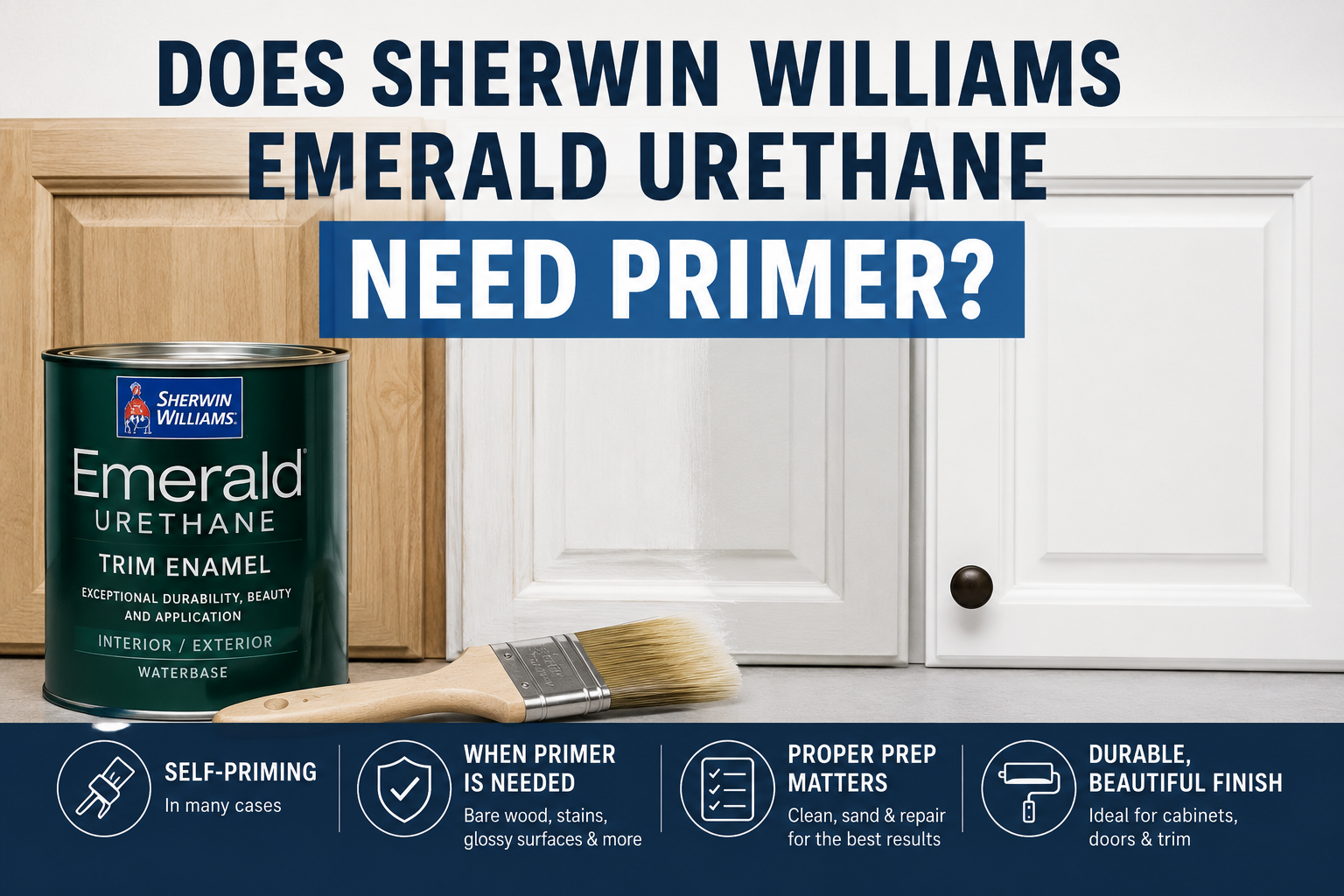
Does Sherwin Williams Emerald Urethane need primer? Not always. Sherwin-Williams describes Emerald Urethane Trim Enamel as self-priming, so a separate primer may not be necessary over a clean, sound, previously painted surface. However, primer is still a smart or necessary step when painting bare wood, stained or tannin-rich wood, glossy surfaces, difficult substrates, patched areas, or surfaces where maximum adhesion and stain blocking are important.
That distinction matters because Emerald Urethane is commonly used on cabinets, doors, trim, and other high-touch surfaces where durability and a smooth finish are especially important. Sherwin-Williams specifically positions the product for interior and exterior doors, trim, and cabinets and describes it as a durable water-based urethane enamel.
What Is Sherwin Williams Emerald Urethane?
Emerald Urethane Trim Enamel is a water-based urethane-modified enamel formulated for surfaces that receive more wear than ordinary walls.
Typical applications include:
- Kitchen cabinets
- Bathroom cabinets
- Doors
- Baseboards
- Crown molding
- Window trim
- Built-in shelving
- Other interior and exterior trim
Sherwin-Williams says the coating is designed to produce a smooth, uniform finish while offering the durability needed for cabinets, doors, and trim. It also has a recoat time of as little as four hours under suitable conditions.
Why Is There Confusion About Primer?
The confusion comes from the fact that Emerald Urethane is described as self-priming.
“Self-priming” does not mean that primer is never useful.
Instead, it means that on an appropriate, properly prepared surface, the first coat can often provide enough adhesion and coverage to function without a separate dedicated primer.
Primer solves problems that finish paint alone may not solve as effectively, such as:
- Blocking stains
- Sealing bare wood
- Improving adhesion
- Controlling tannin bleed
- Creating a uniform substrate
- Bonding to hard or glossy surfaces
- Covering repaired or patched areas
The condition and material of the surface should determine whether primer is needed.
When You May Not Need Primer
If you’re repainting a surface that is already painted and in excellent condition, you may be able to apply Emerald Urethane without a separate primer.
For example, imagine white painted trim that:
- Is firmly bonded
- Has no peeling
- Has no stains
- Has no bare wood exposed
- Has been cleaned thoroughly
- Has been properly scuff-sanded where necessary
In that situation, the self-priming properties of Emerald Urethane may make an additional primer coat unnecessary. Sherwin-Williams currently describes the product as self-priming while emphasizing its hide, leveling, and durability.
However, surface preparation is still essential. Self-priming paint cannot compensate for grease, loose coatings, dirt, or poor adhesion underneath.
When Should You Use Primer?
There are several situations where skipping primer can create unnecessary risk.
Bare Wood
Bare wood is porous and can absorb finish paint unevenly.
Primer helps seal the surface and creates a more consistent foundation for the enamel.
Some wood species also contain natural tannins that can migrate through light-colored coatings. A suitable stain-blocking primer can help reduce this problem.
Sherwin-Williams’ primer selection guidance includes primers designed specifically for wood trim, doors, and other hard-wear surfaces that will later receive finish coatings such as Emerald Urethane.
Stained or Varnished Cabinets
Cabinets often have old clear finishes, stains, oils, grease, or polished surfaces.
Even after cleaning and sanding, a bonding or stain-blocking primer can create a much more dependable foundation before applying enamel.
Cabinets also experience constant touching, cleaning, moisture, and impact. For that reason, maximizing adhesion is usually worth the extra preparation step.
Glossy Surfaces
Glossy coatings can create adhesion problems because they provide very little texture for the new paint to grip.
The surface should normally be cleaned and deglossed or sanded.
For especially hard, slick surfaces, Sherwin-Williams offers Extreme Bond Primer, which is specifically designed to improve adhesion on difficult glossy substrates such as tile, glass, and other hard surfaces.
Dramatic Color Changes
Moving from a very dark finish to white, cream, or another pale color may require multiple finish coats.
A suitable primer, sometimes tinted appropriately, can create a more uniform base and reduce the amount of expensive finish enamel required.
Primer may also help when moving between drastically different colors if the existing surface has uneven patches.
Repairs and Bare Patches
If you’ve filled dents, repaired damaged trim, or sanded through the old finish, portions of the surface may absorb paint differently.
Spot priming or full priming can help prevent flashing and inconsistent sheen.
Do Kitchen Cabinets Need Primer With Emerald Urethane?
For many cabinet refinishing projects, priming is the safer professional approach, even though the finish itself is self-priming.
Cabinets are different from ordinary walls because they can contain:
- Cooking grease
- Cleaning-product residue
- Hand oils
- Existing stain or varnish
- Factory finishes
- Wood tannins
- High-gloss coatings
Sherwin-Williams recommends Emerald Urethane Trim Enamel as a cabinet topcoat and emphasizes its flow, leveling, and durability for cabinets.
The finished enamel is only as reliable as the surface underneath it. For heavily used cabinetry, careful cleaning, sanding, appropriate priming, and multiple controlled coats usually provide a more dependable system than relying solely on the self-priming claim.
What Primer Should You Use?
There isn’t one primer that is correct for every project.
The best choice depends on what you’re painting.
For bare or previously painted wood, a compatible wood or enamel primer may be appropriate.
For stain-prone wood, a stain-blocking primer may be necessary.
For slick or difficult surfaces, a high-adhesion bonding primer may be more appropriate. Sherwin-Williams specifically markets Extreme Bond Primer for surfaces that require stronger adhesion than standard primers can provide.
Because coating compatibility matters, always check the current Sherwin-Williams product data sheet or ask the manufacturer for the recommended primer system for the exact substrate.
Surface Preparation Matters More Than People Think
Using primer does not eliminate the need for preparation.
A properly prepared surface should generally be:
- Clean
- Dry
- Free of grease
- Free of loose paint
- Properly sanded or deglossed where required
- Repaired before coating
If paint is applied over grease or poorly bonded old coatings, the new finish can fail even if premium primer and enamel are used.
This is particularly important on kitchen cabinets, where invisible cooking residue can remain on doors and frames for years.
Should You Sand Before Emerald Urethane?
In many repainting situations, light sanding or deglossing is beneficial.
Sanding helps:
- Remove imperfections
- Smooth old brush marks
- Reduce gloss
- Improve mechanical adhesion
- Create a cleaner final appearance
After sanding, remove all dust before applying primer or finish paint.
The goal isn’t always to strip the surface down to bare wood. Often, you’re simply creating a clean, sound, dull surface that allows the new coating system to bond correctly.
How Many Coats of Emerald Urethane Are Needed?
Even when primer is used, plan for finish coats rather than expecting primer to replace paint.
Sherwin-Williams promotes Emerald Urethane for its hide, flow, leveling, and durable finish, and lists recoating in as little as four hours depending on conditions.
For many cabinet, door, and trim projects, two controlled finish coats provide more consistent color, sheen, and durability than trying to obtain full coverage with one heavy coat.
Always follow the current product instructions regarding application thickness and drying time.
Don’t Apply the Paint Too Thickly
Emerald Urethane is formulated to level into a smooth finish, but applying too much paint at once can work against you.
Heavy coats can increase the chances of:
- Runs
- Sags
- Slow drying
- Soft paint
- Uneven curing
Thin, controlled coats are usually easier to manage and create a more professional-looking finish.
Is Emerald Urethane Good for Cabinets?
Emerald Urethane is specifically marketed by Sherwin-Williams for cabinets as well as doors and trim. The company highlights its durable finish and leveling properties, which are particularly desirable on cabinetry where visible brush and roller marks can detract from the final result.
That doesn’t mean the product alone determines the outcome.
Cleaning, repairs, sanding, priming when appropriate, application technique, and proper drying all contribute to the finished durability.
A premium topcoat cannot fix weak preparation underneath.
When Skipping Primer Can Cost More
It may seem like skipping primer saves both time and money.
Sometimes it does.
But if the surface actually requires primer, skipping it can lead to:
- Stains bleeding through
- Poor adhesion
- Uneven coverage
- Additional finish coats
- Premature peeling
- Complete refinishing later
Because Emerald Urethane is a premium finish product, using extra coats of enamel to solve problems that could have been addressed with the correct primer can actually become more expensive.
Professional Painting Takes the Guesswork Out
The hardest part is often not applying the paint. It’s determining what is already on the surface and what preparation system will work with it.
Experienced painters evaluate the existing coating, substrate, sheen, stains, repairs, and intended use before selecting primer and finish products.
If you’re planning cabinet, trim, door, or whole-home painting, our residential painters Charlotte NC can help determine the right preparation and coating system for your project.
Century Painting & More has served homeowners throughout the Charlotte area since 1999, focusing on careful preparation, quality materials, clear communication, and durable professional finishes.
Final Thoughts
So, does Sherwin Williams Emerald Urethane need primer? The answer is sometimes.
Emerald Urethane Trim Enamel is self-priming, which means a separate primer may not be necessary on clean, sound, properly prepared previously painted surfaces. Sherwin-Williams currently describes the coating as self-priming and specifically recommends it for cabinets, doors, and trim.
But primer remains valuable when working with bare wood, stained cabinetry, glossy finishes, tannin-prone wood, patches, difficult substrates, or surfaces where maximum adhesion is important. Rather than thinking of primer as an automatic step or something that should always be skipped, evaluate the surface first. Understanding does Sherwin Williams Emerald Urethane need primer for your specific project can mean the difference between a finish that simply looks good today and one designed to hold up for years.