
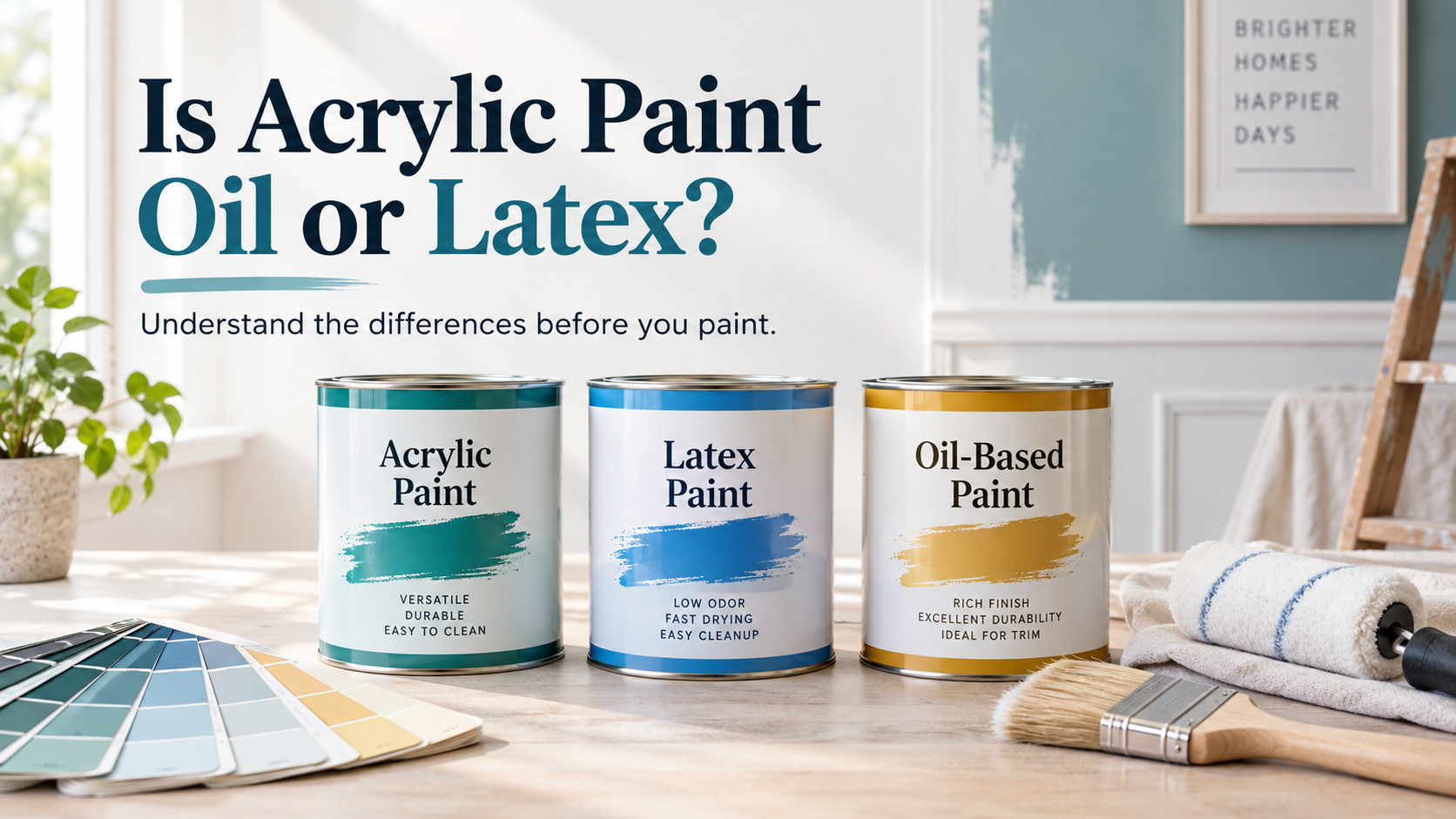
If you are wondering is acrylic paint oil or latex, the most accurate answer is that standard architectural acrylic paint is usually water-based, which places it much closer to latex paint than to traditional oil-based paint.
However, that short answer does not tell the whole story.
Modern paint labels use terms such as acrylic, latex, acrylic latex, waterborne enamel, and alkyd in ways that can confuse homeowners. In many cases, “latex” refers broadly to water-based architectural paint, while “acrylic” describes the type of resin used as the binder.
That means an acrylic paint can also be sold as an acrylic latex paint.
Understanding how these categories overlap is important because paint chemistry affects adhesion, flexibility, drying time, cleanup, durability, and where a product should be used.
Is Acrylic Paint Oil or Latex?
If your question is is acrylic paint oil or latex, acrylic paint is generally a water-based paint and is much more closely related to latex paint than to oil paint.
Traditional oil-based paint relies on an oil or alkyd resin system.
Acrylic architectural paint, by contrast, usually uses acrylic polymer resin suspended or dispersed in water.
As the paint dries:
- Water evaporates.
- The acrylic particles come together.
- A continuous paint film forms over the surface.
That is very different from the way traditional oil-based coatings cure.
Why the Words Acrylic and Latex Cause So Much Confusion
The confusion comes from the fact that “latex” and “acrylic” do not always describe completely separate categories.
Latex Usually Refers to the Paint System
In architectural coatings, latex generally means a water-based paint.
It does not usually mean that the paint contains natural rubber latex.
Instead, the binder is made from synthetic polymers.
Acrylic Refers to the Resin
Acrylic describes the type of polymer resin used to form the paint film.
So a product may correctly be described as:
- Acrylic paint
- Acrylic latex paint
- 100% acrylic latex paint
- Water-based acrylic coating
These terms can overlap.
That is why homeowners should read the full product label instead of relying on one word on the front of the can.
What Is Acrylic Paint Made Of?
Architectural acrylic paint usually contains several basic components.
Acrylic Polymer Binder
The binder is what holds the pigment together and attaches the coating to the surface after drying.
High-quality 100% acrylic resins are valued for adhesion, flexibility, and weather resistance.
Pigments
Pigments give paint its color and opacity.
Different pigments can also influence fade resistance and coverage.
Water
Water acts as the main carrier in most modern acrylic architectural paints.
That is what makes the paint easier to apply and clean up while wet.
Additives
Manufacturers may also include additives that help control:
- Flow
- Mildew resistance
- Drying
- Foam
- Texture
- Adhesion
- Freeze-thaw stability
- Stain resistance
The exact formulation depends on whether the product is made for interior walls, exterior siding, trim, masonry, or another specific surface.
How Acrylic Paint Differs From Traditional Oil-Based Paint
The biggest difference is the binder and drying system.
Oil-based paint typically uses an alkyd or drying-oil system and cures more slowly.
Acrylic paint usually forms a film as water evaporates.
Here is a practical comparison:
| Feature | Acrylic Paint | Oil-Based Paint |
|---|---|---|
| Typical base | Water | Oil or alkyd |
| Cleanup | Soap and water when wet | Usually mineral spirits or solvent |
| Drying | Faster | Slower |
| Flexibility | Generally high | Can become brittle with age |
| Odor | Usually lower | Typically stronger |
| Yellowing | Minimal | Can yellow over time |
| Exterior use | Excellent with the right product | Used selectively |
| UV resistance | Often strong | Varies |
| Recoat time | Usually shorter | Usually longer |
For most residential projects today, acrylic and acrylic-latex products are extremely common because they offer a useful balance of durability and convenience.
Is Acrylic Paint the Same as Latex Paint?
Not exactly, but the two categories overlap substantially.
Latex is a broad term for water-based architectural paint.
Acrylic describes the resin.
Some latex paints use vinyl-acrylic binders, while premium products may use 100% acrylic resin.
That is why one gallon may say “interior latex” while another says “100% acrylic latex.”
Both are water-based, but their performance can be different.
What Is Acrylic Latex Paint?
Acrylic latex paint combines the water-based convenience associated with latex paint and the performance characteristics of acrylic resin.
This makes it one of the most commonly used categories for residential and commercial painting.
Depending on the formulation, acrylic latex can provide:
- Strong adhesion
- Good color retention
- Flexibility
- Resistance to cracking
- Moisture resistance
- Easy cleanup
- Faster drying
- Interior and exterior versatility
For many projects, this category provides a practical middle ground between older traditional latex formulas and conventional oil-based coatings.
Why Acrylic Paint Works So Well Outdoors
Acrylic paint is especially useful on exterior surfaces because buildings constantly move.
Wood expands and contracts.
Siding heats up and cools down.
Stucco absorbs and releases moisture.
Trim is exposed to sunlight, rain, and seasonal temperature changes.
A flexible acrylic coating can better tolerate that movement than a paint film that becomes excessively hard or brittle.
UV Resistance
Premium acrylic exterior paints are formulated to resist sunlight and color fading.
This is particularly important on:
- South-facing walls
- West-facing elevations
- Dark exterior colors
- Trim exposed to direct sunlight
Moisture Resistance
Once fully cured, acrylic coatings can provide strong resistance to rain and humidity while still allowing the coating system to perform appropriately for the substrate.
Flexibility
Acrylic resin can expand and contract with the surface more effectively than many older coatings.
That helps reduce the risk of cracking and peeling when the surface moves.
Where Acrylic Paint Is Commonly Used
Modern acrylic coatings can be used on many surfaces when the product is specifically designed for them.
Common applications include:
- Exterior siding
- Stucco
- Fiber cement
- Masonry
- Wood trim
- Doors
- Drywall
- Interior walls
- Ceilings
- Cabinets
- Concrete
- Properly prepared metal
The important phrase is properly designed for the surface.
Not every acrylic product should be used on every material.
Acrylic craft paint, for example, is not the same thing as an exterior architectural acrylic coating.
Acrylic Paint vs. Latex Paint for Interior Walls
For ordinary interior walls, both acrylic and latex products can work very well.
In practice, many premium interior paints are already acrylic latex products.
A homeowner should focus on:
- Washability
- Stain resistance
- Sheen
- Coverage
- Low odor
- Touch-up performance
- Manufacturer recommendations
For bedrooms, living rooms, and ceilings, standard high-quality water-based paint is usually sufficient.
For hallways, kitchens, bathrooms, and high-contact surfaces, a more durable acrylic formulation may be worthwhile.
Acrylic Paint vs. Oil Paint for Trim
Trim is where the comparison becomes more interesting.
Oil-based paint has traditionally been valued for its smooth leveling and hard finish.
Modern acrylic enamels and waterborne alkyds, however, can now provide excellent trim performance without many of the disadvantages of conventional oil paint.
For trim, doors, and molding, look for products designed to provide:
- Hard curing
- Blocking resistance
- Smooth leveling
- Washability
- Scuff resistance
- Strong adhesion
The best choice may not simply be labeled “acrylic” or “oil.”
Modern enamel technology includes several hybrid systems.
Can Acrylic Paint Be Applied Over Oil-Based Paint?
Yes, but not without proper preparation.
This is one of the most common causes of paint failure in older homes.
Applying acrylic directly over a slick oil-based coating can result in poor adhesion.
The new paint may:
- Scratch off
- Peel
- Chip
- Lift around edges
- Separate during cleaning
Proper Preparation Can Include
- Cleaning grease and dirt
- Deglossing the surface
- Light sanding
- Removing loose material
- Dust removal
- Applying a compatible bonding primer
- Applying the correct topcoat
Always follow the primer and paint manufacturer’s instructions.
Can Oil-Based Paint Go Over Acrylic Paint?
It can in some situations, but the surface must be sound and properly prepared.
Still, switching from a modern acrylic system to traditional oil paint is not always necessary.
Before changing paint chemistry, ask what problem you are actually trying to solve.
Do you need:
- Better leveling?
- Greater hardness?
- Faster drying?
- Better exterior flexibility?
- Improved adhesion?
- Better moisture resistance?
A modern acrylic enamel or waterborne alkyd may provide the desired performance without returning to a conventional solvent-based system.
How to Tell Whether Existing Paint Is Acrylic, Latex, or Oil Based
In older homes, identifying the previous coating can be important before repainting.
Look at the Age of the Paint
Very old trim and doors are more likely to have been painted with oil-based products.
Recent wall and exterior coatings are more likely to be acrylic or latex.
Age alone is not conclusive.
Look for Yellowing
Older oil-based white paint often develops a yellow or amber cast.
Modern acrylics usually retain white color better.
Look at Flexibility and Cracking
Older oil coatings can become brittle and develop fine cracking.
Acrylic coatings tend to remain more flexible.
Use a Proper Coating Test
When compatibility matters, testing a small inconspicuous area is more reliable than guessing.
Professional painters may use suitable testing methods and surface evaluation before deciding on primer and topcoat.
Acrylic Paint Advantages
Acrylic paint is popular because it performs well in many environments.
Key benefits include:
- Excellent flexibility
- Strong adhesion
- Faster drying
- Good color retention
- Easy cleanup while wet
- Good exterior weather resistance
- Resistance to cracking and peeling
- Broad range of sheens and colors
- Low odor compared with traditional oil products
- Strong performance on properly prepared surfaces
For exterior work especially, 100% acrylic products are often among the strongest choices available.
Possible Disadvantages of Acrylic Paint
No paint type is perfect for every situation.
Acrylic products can have limitations.
Fast Drying Can Reduce Working Time
Faster drying is usually convenient, but it gives painters less time to brush out or correct certain areas.
Premium Products Cost More
High-quality 100% acrylic paints are often more expensive than basic water-based products.
However, longer service life and better durability may offset that cost.
Preparation Still Matters
Strong adhesion does not mean acrylic can be applied over dirty, glossy, damp, or unstable surfaces without preparation.
No premium coating can overcome serious substrate problems indefinitely.
Which Type of Paint Should You Choose?
When deciding between acrylic, latex, and oil-based products, do not choose by label alone.
Match the coating to the surface and environment.
Choose High-Quality Acrylic or Acrylic Latex for:
- Exterior siding
- Stucco
- Wood
- Fiber cement
- Masonry
- Interior walls
- Bathrooms
- Kitchens
- High-traffic areas
- Many trim applications
Consider Specialty Alkyd or Oil-Type Products for:
- Some metal applications
- Certain stain-blocking situations
- Select restoration projects
- Specific manufacturer-recommended systems
- Projects requiring specialized leveling or curing characteristics
A Better Way to Compare Paint Products
Instead of asking which paint category is universally best, compare actual product performance.
Look at:
- Recommended substrate
- Interior or exterior rating
- Adhesion requirements
- Primer requirements
- VOC level
- Drying time
- Recoat time
- Washability
- Mildew resistance
- UV resistance
- Sheen
- Expected durability
Two products labeled “acrylic” can perform very differently if one is an economy wall paint and the other is a premium exterior coating.
Common Mistakes Homeowners Make
Assuming Acrylic Means Oil-Based
It does not.
Standard architectural acrylic paint is generally water-based.
Assuming Latex and Acrylic Are Completely Different
Many latex paints use acrylic resin, which is why “acrylic latex” is such a common label.
Painting Over Old Oil Paint Without Preparation
Even excellent acrylic paint can fail if it cannot bond to the existing surface.
Choosing by Price Alone
A lower-cost coating may require more coats or need repainting sooner.
Ignoring Surface Condition
Peeling, moisture damage, rot, chalking, and glossy surfaces should be corrected before repainting.
Frequently Asked Questions
Is Acrylic Paint Oil or Latex?
If you are asking is acrylic paint oil or latex, standard architectural acrylic paint is usually water-based and is much closer to latex paint than to traditional oil paint.
Is Acrylic Paint Water Based?
Most modern architectural acrylic paints are water-based.
Always check the product label because specialty coatings can use different chemistry.
Is Acrylic Latex Paint the Same as Acrylic Paint?
They overlap significantly.
Acrylic latex paint is water-based paint that uses acrylic resin as part or all of its binder system.
Is Acrylic Better Than Latex?
Not automatically.
Performance depends on formulation, resin quality, surface, preparation, and environment.
Premium acrylic products often provide better exterior flexibility and durability than lower-cost latex formulas.
Is Acrylic Better Than Oil Paint?
For many modern residential applications, acrylic offers strong durability with faster drying, easier cleanup, lower odor, and better flexibility.
Oil-based products can still be useful for specialized situations.
Can Acrylic Paint Be Used on Exterior Wood?
Yes, when the product is specifically formulated for exterior wood and the surface is properly prepared.
Does Acrylic Paint Need Primer?
Sometimes.
Primer needs depend on the substrate, existing coating, stains, repairs, gloss level, and manufacturer instructions.
Choosing the Right Paint Is More Important Than Choosing the Right Label
So, is acrylic paint oil or latex? In most residential painting applications, acrylic paint is a water-based coating and is closely related to latex paint rather than traditional oil-based paint. Many of today’s best-performing products are actually acrylic latex coatings, combining easy cleanup and lower odor with improved adhesion, flexibility, and durability. The best choice still depends on the surface, existing coating, exposure, and preparation requirements. If you want the paint system selected and applied correctly from the start, experienced Painters in Davidson nc can evaluate the surface and recommend an appropriate coating for your interior or exterior project.